
Useful information
Cellulite: Why Does It Occur and Which Treatments Can Improve the Appearance of the Skin?
Today, we will discuss: • Why cellulite occurs and why it may be present even in people who are slim or physically active. • Which treatment options are available, from radiofrequency and acoustic wave therapy to procedures that release the fibrous septa. • What results can realistically be achieved and how to choose the right treatment for you.
Patient Guide
Cellulite is a change in the surface texture of the skin that appears as small dimples, uneven areas, and the characteristic “orange-peel” appearance. It most commonly occurs on the thighs, buttocks, and hips and is very common in women, regardless of body weight or level of physical activity.
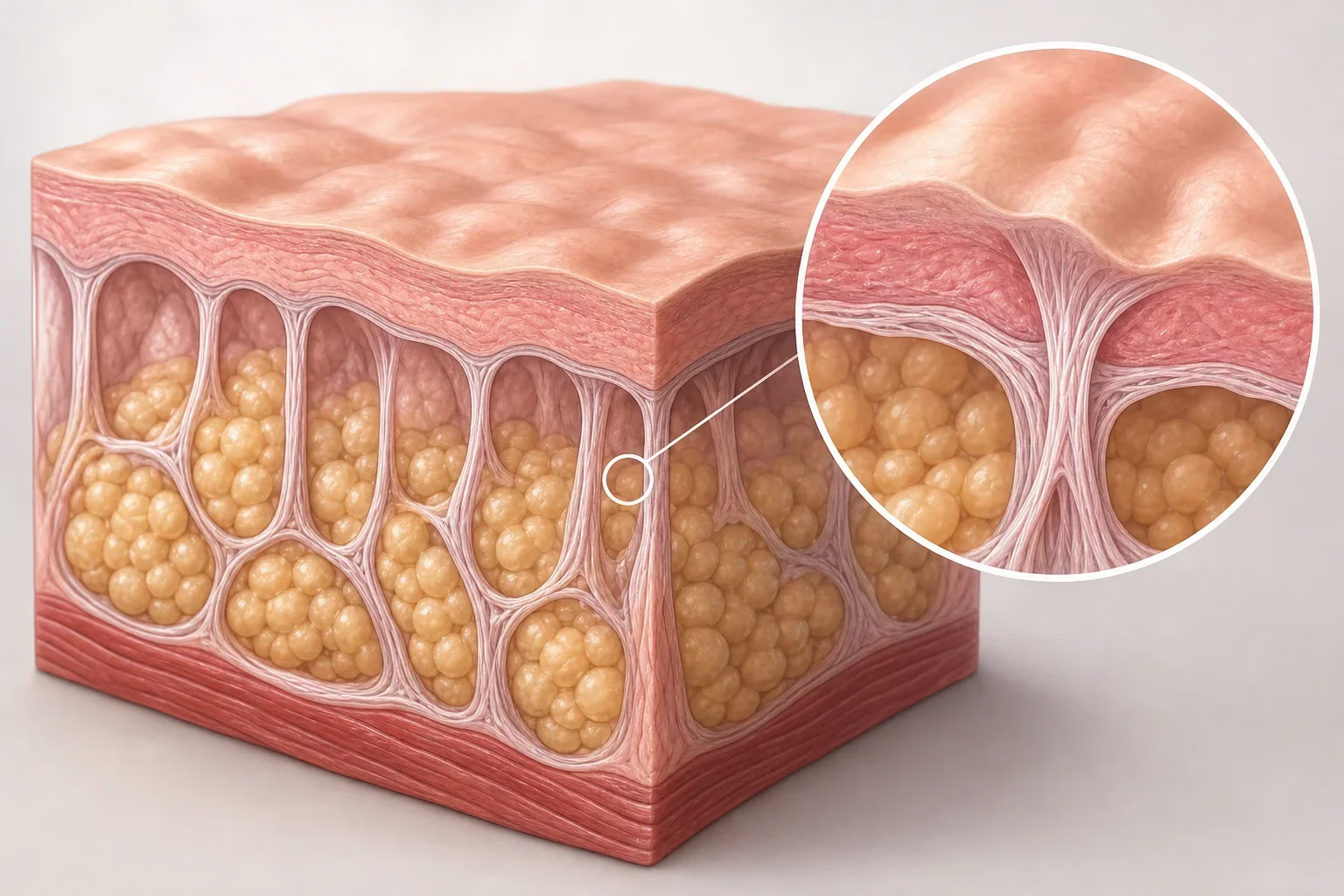
The appearance of cellulite is influenced by the structure of the subcutaneous tissue, the fibrous septa that connect the skin to deeper tissues, the distribution of fatty tissue, and skin elasticity. Therefore, cellulite is not simply excess fat and does not, in itself, indicate a health problem.
Key points
- Cellulite is not the same as excess fat. It may also be present in people of normal weight or those who exercise regularly.
- There is no universal treatment. Radiofrequency, acoustic wave therapy, and subcision work through different mechanisms and have different levels of evidence regarding their effectiveness.
- Results should be assessed realistically. Many procedures reduce the appearance of cellulite without eliminating it completely, and some require repeated sessions or maintenance treatments.
In this article
01
Why Does Cellulite Occur and What Influences the Appearance of the Skin?
To understand why treatments differ, it is important to know that cellulite has a multifactorial origin.
Fibrous septa and the architecture of subcutaneous tissue
Fibrous septa are bands of connective tissue that cross the fatty tissue and connect the skin to deeper structures. When they pull on the skin and the adjacent fatty tissue protrudes between them, the characteristic cellulite dimples appear. This mechanism explains why certain procedures aim to mechanically release the septa rather than simply reduce fat volume.
Skin elasticity and thickness
Age-related changes, including reduced elasticity and thinning of the dermis, can make uneven areas more visible. Therefore, treatments intended to improve skin firmness may have a role in certain cases, even if they do not remove the fibrous septa responsible for the dimples.
Individual factors
Genetic predisposition, hormonal influences, the distribution of fatty tissue, and weight fluctuations may contribute to the development or worsening of cellulite. Body weight may influence its appearance, but it is not the only determining factor.
In practice, the assessment should distinguish between fixed dimples associated with septal traction, a diffuse uneven skin texture, and skin laxity. These features may require different treatment approaches.
02
What Treatment Options Are Available for Cellulite?
Non-surgical treatments: Radiofrequency, mechanical massage, and acoustic wave therapy
These are commonly chosen by patients who want to improve the appearance of their skin without invasive procedures.
Radiofrequency (RF) uses electromagnetic energy to heat tissues. Depending on the device and the parameters used, heating may promote collagen remodelling and temporarily improve skin firmness and the appearance of uneven areas. Some devices combine radiofrequency with vacuum or mechanical massage. Results vary and are generally moderate, while maintaining them may require repeated sessions.
Acoustic wave therapy uses mechanical waves applied to the tissues. Studies suggest that it may reduce the visibility of cellulite after several sessions, but the extent and duration of the effect differ between patients and treatment protocols.
Mechanical massage and vacuum may temporarily improve the appearance of the skin. However, the evidence regarding their sustained effectiveness is inconsistent, and these methods should not be presented as permanent solutions.
It is important to note that results obtained with one device cannot automatically be extrapolated to all devices in the same category. The technology used, the device’s indication, and the treatment protocol influence both effectiveness and the safety profile.
Subcision and minimally invasive treatments
For well-defined dimples caused predominantly by the traction of fibrous septa, procedures that release these structures may be more appropriate than treatments aimed exclusively at skin firmness.
Subcision involves the controlled cutting of the fibrous septa located beneath the skin using an instrument inserted through a small incision or puncture. Releasing the traction allows the dimple to rise and may provide lasting results in selected cases.
Subcision is not necessary for all forms of cellulite. In cases involving a diffuse appearance, predominantly skin laxity, or other changes in body contour, the doctor may recommend a different approach or a combination of treatments.
Creams, lifestyle, and the limitations of treatments
Anti-cellulite creams may have limited effects, particularly on the temporary appearance of the skin.
Products containing caffeine may temporarily reduce the visibility of uneven areas but require repeated application. Products containing topical retinol may help improve skin thickness and texture after long-term use, but their effect on cellulite is usually modest. Retinol may cause irritation, and skin tolerance should be assessed.
Regular physical activity and strength training may improve body composition and muscle contour, sometimes helping to reduce the visibility of cellulite. If excess weight is present, weight loss may be helpful, but it does not guarantee that the dimples will disappear. In some situations, skin laxity after weight loss may make cellulite more noticeable.
It is important to distinguish between reducing fatty tissue and treating cellulite. For example, liposuction is intended to remove fat and is not a first-line treatment for cellulite; it may sometimes accentuate existing irregularities. Procedures for localised fat reduction should not automatically be considered anti-cellulite treatments either.
Mesotherapy with injectable mixtures, supplements promoted as anti-cellulite solutions, and procedures without strong clinical evidence require caution. Uncertain benefits and the risks of adverse reactions should be discussed before any intervention.
03
How Is the Right Treatment Chosen?
There is no single procedure that is optimal for everyone. The choice depends on the clinical appearance, the severity of the uneven areas, skin elasticity, medical history, and the patient’s tolerance for risks and recovery time.
In general:
• For a diffuse appearance with mild changes in skin texture and firmness, non-surgical procedures such as radiofrequency or acoustic wave therapy may be considered.
• For well-defined dimples associated with traction from the fibrous septa, the indication for a subcision procedure may be assessed.
• When skin laxity or excess fatty tissue predominates, the treatment plan should be adapted to the main concern, without assuming that fat reduction will automatically eliminate cellulite.
Standardised photographs taken under comparable conditions may help assess the result objectively.
Final takeaway
Conclusion
Cellulite is a common change in the structure of the skin and subcutaneous tissue, and effective treatment begins by identifying the predominant mechanism in each case. Radiofrequency, acoustic wave therapy, and subcision may improve the appearance of the skin in selected patients, but results vary and there is no universal solution. A dermatology consultation can help you choose an option suited to your needs and establish realistic expectations.
Medical information notice
This material is for informational purposes and does not replace a medical consultation, diagnosis, or personalised recommendation from a doctor.
Frequently asked questions
Can cellulite disappear completely?
In most cases, the realistic goal is to reduce the visibility of uneven areas rather than eliminate them permanently. Some procedures may provide lasting results, particularly for well-defined dimples, but the effect depends on the technique and individual characteristics.
Can I have cellulite even if I exercise and have a normal weight?
Yes. Cellulite is influenced by the architecture of connective tissue, the distribution of fatty tissue, skin elasticity, and genetic and hormonal factors. It may also occur in people who are slim, physically active, or have well-developed muscle mass.
Does losing weight eliminate cellulite?
Not necessarily. If excess weight is present, weight loss may reduce the visibility of cellulite, but the dimples may persist. If skin laxity develops after weight loss, the uneven areas may become even more noticeable.
Medical sources
- 1
Cellulite treatments: What really works?
American Academy of Dermatology Association
- 2
Cellulite: an evidence-based review
American Journal of Clinical Dermatology
- 3
Treatment of cellulite: Part II. Advances and controversies
Journal of the American Academy of Dermatology
Continue reading
Related medical articles

Protein After 40: How Much Is Enough?
After the age of 40, the body does not suddenly lose its ability to preserve muscle mass, but it becomes increasingly important to provide it with two essential elements: the stimulus provided by strength training and the protein needed for recovery and adaptation. In this article, you will learn how much protein we need, how we can distribute it throughout the day, and why maintaining muscle strength is essential for metabolism, mobility, and long-term independence.
Hair Loss in Men: Causes, Diagnosis, and Treatment Options
Hair loss is common in men, but not all forms of alopecia have the same cause or require the same treatment. You will learn how to recognize the main signs of androgenetic alopecia, when a dermatology consultation is recommended, and which treatment options are best supported by research.
Metabolic fatty liver disease (MASLD): the silent disease that goes hand in hand with insulin resistance
Metabolic fatty liver disease, now known as MASLD (metabolic dysfunction-associated steatotic liver disease), occurs when fat accumulates in the liver in association with one or more cardiometabolic risk factors. Below, we explain its connection with insulin resistance, why it may be present even when transaminase levels (AST/TGO, ALT/TGP) are normal, how the risk of fibrosis is assessed, and what measures may prevent the disease from progressing.