Patient guide
Where Should Insulin Be Injected? A Practical Guide to Choosing and Rotating Injection Sites
This article explains the recommended injection sites, how to position the pen correctly, and why rotating injection sites is essential for making absorption as predictable as possible.
Patient guide
Administering insulin correctly involves more than choosing the right dose. The injection site, needle length, and repeated use of the same area can affect insulin absorption and, consequently, blood glucose levels.
Key points
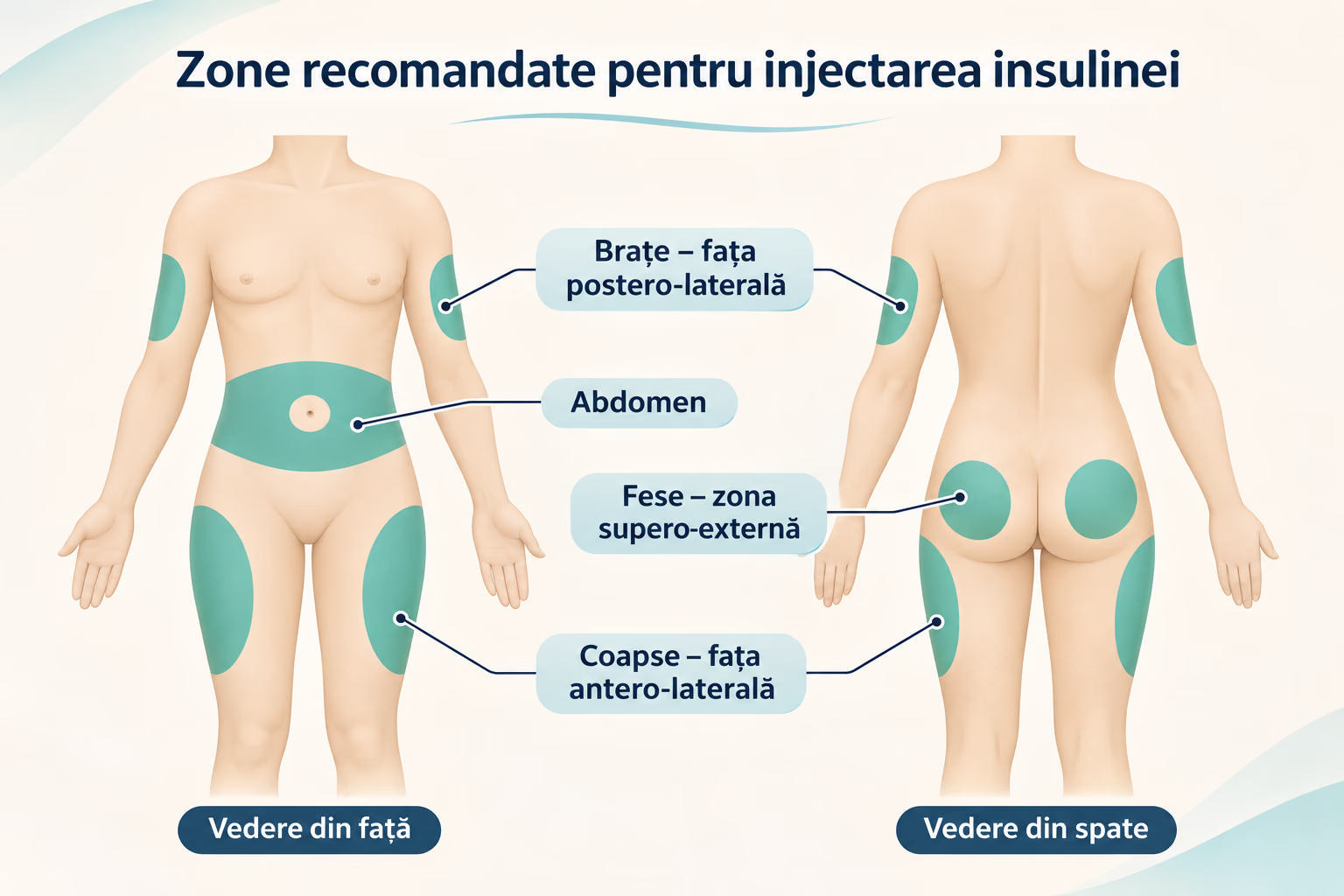
- Insulin is injected into the subcutaneous tissue of the abdomen, thighs, buttocks, or upper arms.
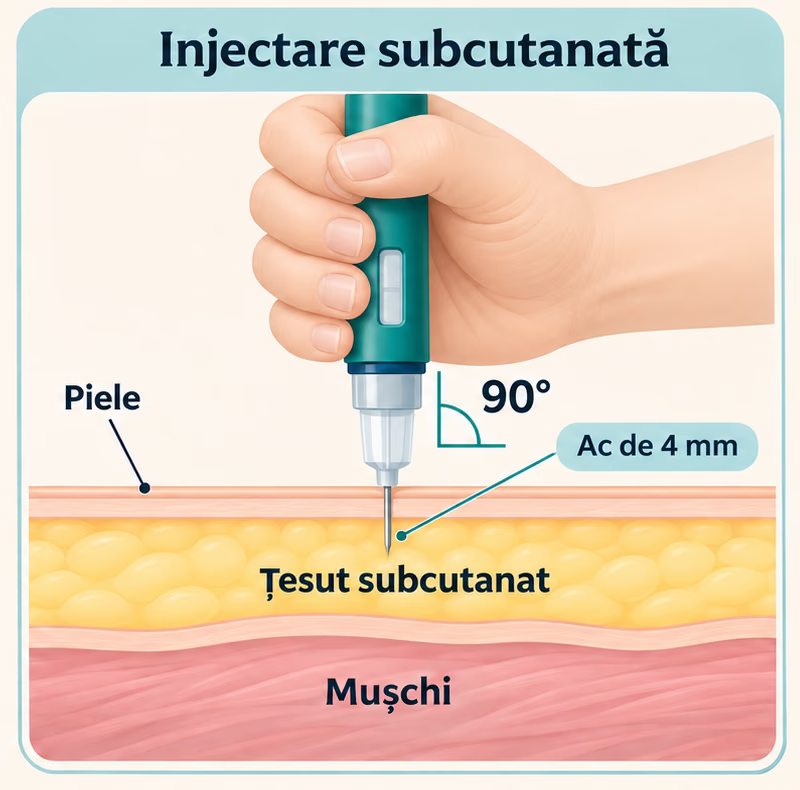
- When using a 4 mm needle, the pen is generally positioned perpendicular to the skin, at a 90° angle.
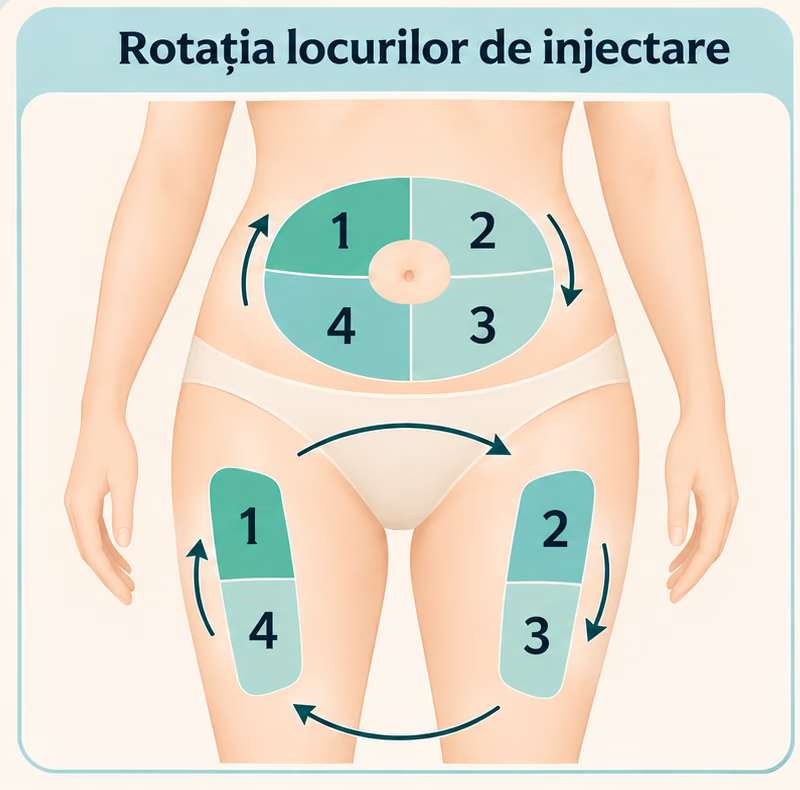
- Injection sites should be rotated systematically, leaving at least 1 cm between two consecutive injections.
In this article
01
What are the correct areas for injecting insulin?
The recommended sites are those that allow insulin to be administered into the layer of fat immediately beneath the skin: the abdomen, thighs, buttocks, and back of the upper arms. The thickness of subcutaneous tissue varies between individuals and between different areas of the body, so the choice of site should be adapted to each person’s build.
The abdomen provides a large surface area for rotation. The area between the ribs and the lower abdomen, including the sides, may be used, while avoiding the region immediately around the navel. As a practical rule, it is recommended to keep approximately 5 cm away from the navel.
The entire surface of the leg is not suitable for a thigh injection. The appropriate area is the front outer or outer part of the thigh, particularly the upper and middle thirds. Avoid the inner thigh, the area very close to the groin crease, and the area around the knee. The injection should be given where there is sufficient subcutaneous tissue, not directly into a very muscular area.
The upper arm may be used in the middle third of its back or back outer surface. Self-administration may be more difficult because positioning the pen and correctly forming a skinfold are not always easy. The buttocks may be used in the upper outer or back outer area, including toward the flanks.
02
How should the injection be administered correctly?
A 4 mm needle is recommended for most children and adults, regardless of weight, because it allows the insulin to reach the subcutaneous tissue and reduces the risk of an intramuscular injection. The pen should be held perpendicular to the surface of the skin, at a 90° angle.
In general, adults do not need to form a skinfold when using a 4 mm needle. A skinfold may be necessary for young children, very thin individuals, when using longer needles (6 or 8 mm), or when the distance between the skin and muscle is small. The technique should be demonstrated individually by a doctor or nurse, especially if longer needles are used.
After inserting the needle, press the pen button down fully and keep the needle under the skin for approximately 10 seconds before withdrawing it. This pause reduces the risk of some insulin leaking onto the skin’s surface. The needle should be changed after every administration and discarded in a designated sharps container.
The skin should be checked before every injection. Do not inject into areas that are inflamed, infected, ulcerated, swollen, painful, or bruised. It is preferable to avoid scars and prominent stretch marks. Injecting through clothing is not recommended because the skin cannot be inspected properly.
03
Why is rotating injection sites essential?
Repeated injections into the same site can cause lipohypertrophy. This may be visible as a soft swelling or may feel like a denser, thickened, or “rubbery” area when touched. Patients sometimes prefer these sites because injections hurt less, but insulin absorption may become unpredictable, leading to fluctuations in blood glucose and unexplained episodes of hypoglycaemia or hyperglycaemia.
Rotation does not mean randomly choosing a different region for every dose. One simple method is to divide the abdomen into quadrants and the thighs, arms, or buttocks into halves. Use one area for approximately one week, placing each injection at least 1 cm away from the previous one, and then move systematically to the next area.
Injection sites should be inspected and palpated periodically. If an area suspected of lipohypertrophy is identified, insulin should no longer be administered there. Moving from altered tissue to healthy tissue may increase insulin absorption and contribute to hypoglycaemia. Blood glucose levels should therefore be monitored more closely, and doses should not be changed without advice from the medical team.
Movement can affect absorption from a limb. For example, injecting into the thigh before intense physical activity involving the legs may make the insulin’s effect less predictable. The choice of site should take into account the type of insulin, the timing of administration, and the planned activity.
Final takeaway
Conclusion
Good injection technique can make insulin treatment safer and more predictable. The most important rules are to choose an area with sufficient subcutaneous tissue, use the needle correctly, and rotate injection sites systematically.
Medical information notice
This material is for informational purposes and does not replace a medical consultation, diagnosis, or personalised recommendation from a doctor.
Frequently asked questions
Where on the thigh should insulin be injected?
Into the front outer or outer part of the thigh, usually in the upper and middle thirds. Avoid the inner thigh, the area close to the groin crease, and the area around the knee. To identify the area more easily, place one palm over the groin area and the other above the knee, then imagine a line running from the knee to the groin. The recommended injection site is the outer surface bordered by this imaginary line and the edges of the palms.
Can I inject insulin into a hardened area if the injection hurts less there?
No. A thickened or raised area may be lipohypertrophy, and insulin absorption may be unpredictable. The area should be avoided and assessed during a medical consultation.
Do I always need to form a skinfold?
No, not when using a 4 mm needle. A skinfold may be necessary for young children, very thin individuals, or in certain anatomical areas, as advised by a doctor or nurse. However, a skinfold is necessary when using longer needles (6 or 8 mm).
Medical sources
- 1Standards of Care in Diabetes 2026: Pharmacologic Approaches to Glycemic Treatment
American Diabetes Association
- 2
- 3Consensus Recommendations on Lipohypertrophy: Insights From an International Panel of Experts
Diabetes Res Clin Pract. 2026
- 4Lipohypertrophy and Insulin: An Update
Diabetes Technology Society
Continue reading
Related medical articles

Glycated Hemoglobin (HbA1c): What It Shows, Values, and Interpretation
This patient-friendly guide explains what the glycated hemoglobin (HbA1c) test measures, how the values used for screening and diagnosis are interpreted, why the result sometimes needs to be confirmed, and which situations may affect its accuracy.

Guide for Patients with Acne